In a small garden it's impossible to grow the diversity of flowering plants that I would if I had more room. So for the August 2012 Garden Bloggers Blooms Day, kindly hosted by
May Dreams Gardens, there are bound to be plants I've illustrated before. No matter, here's a good sample of what's in flower at the moment.
I'll start with two
Agapanthus. These are both deciduous hybrids, hardy plants - unlike their evergreen cousins - but still desirable. The paler blue, 'Bressingham Blue', I've had for years, while the more impressive darker blue 'Northern Star' is a more recent acquisition. No
Agapanthus is a particularly fast spreader but this one looks quite vigorous and I look forward to seeing a good clump of this developing in years to come. I'm revamping the border where it sits this autumn and I think I'll underplant it with some of the bulbs of
Allium 'Globemaster' that I've been growing on the allotment for cut flowers.
 |
| Agapanthus 'Bressingham Blue' |
 |
| Agapanthus 'Northern Star' |
With my slug and snail population ever eager to munch their way through anything soft and fleshy I have difficulty with Dahlias but 'Procyon' has run the gauntlet and is now producing quite a good display. I do like the colour combination - and it survives my winters in situ.
 |
| Dahlia 'Procyon' |
Behind it in the border is
Fuchsia 'Mrs Popple'. I've written about this one in a previous post but it's now in full flower and dripping with it's relatively large scarlet and orange flowers.
 |
| Fuchsia 'Mrs Popple' |
In the little pool garden
Hedychium 'Stephen' is just beginning to open the lowest few flowers on the first of the eight spikes produced by the clump this year. The copious rain this year (including today!) has helped to bring these to flowering a week or so earlier than normal. They'll be in full bloom in a week or so but this gives me the opportunity to show the delicate beauty of the individual flowers, rather than the massed assemblage of the flower spike. They won't last long - the end of August will see them over - but they are so attractive in both foliage and flower that I'd always make space for them wherever I gardened. Now, if only my other four hedychiums will be as obliging...
 |
| Hedychium 'Stephen' - individual flowers |
Up the cherry tree
Passiflora caerulea is busily wending its annual way. It was late in flower this year, a direct result of our cold summer, but at least it survived and is now showing flowers both close to the ground and 15ft / 5 metres up in the branches of the tree. It's very attractive to bumble bees as well.
 |
| Passiflora caerulea |
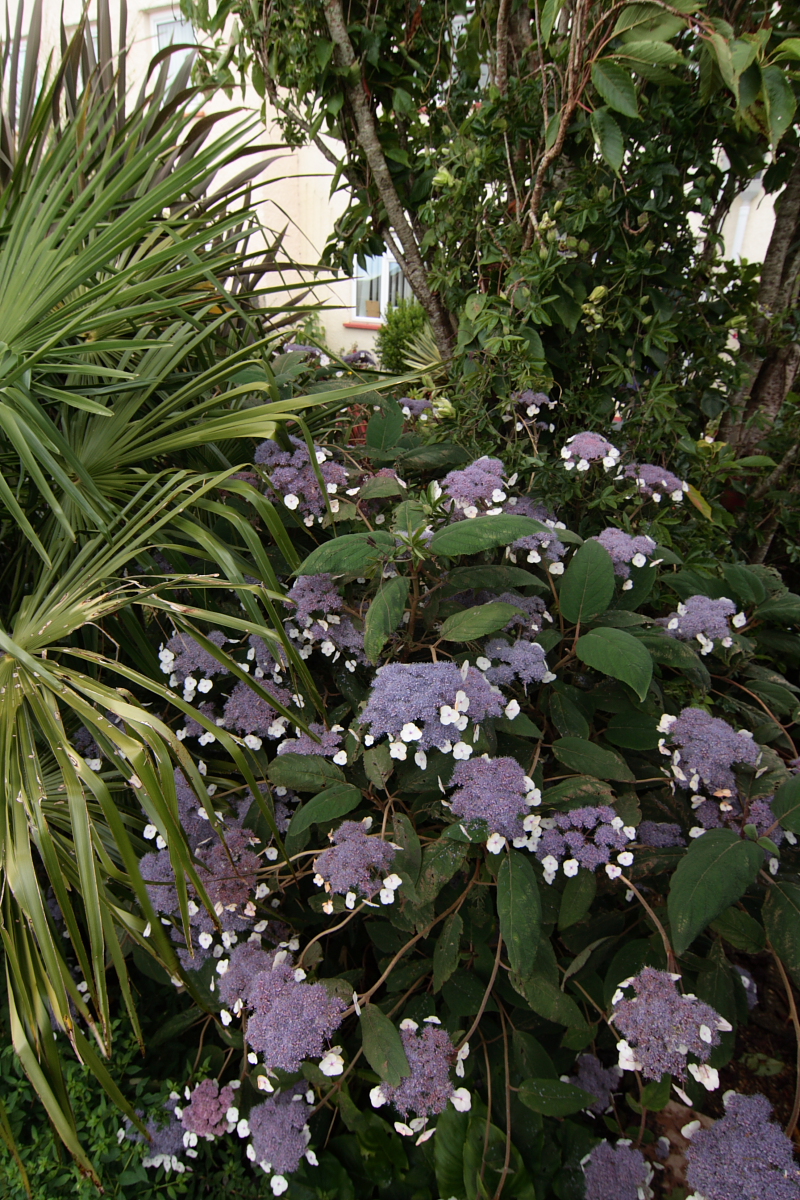
I grow four hydrangeas in the garden but the star of the show at the moment is
Hydrangea aspera var
sargentiana. Big, dark green, velvety leaves are a perfect complement to the heads of purple florets, each surrounded by a pure white set of sterile florets designed to attract insects. It's a fabulous plant, though it does have two problems. Firstly, the flower heads go over quite quickly and loose their attraction. Secondly, it can make quite a tall, gawky shrub - with too many of the flower heads in the upper canopy. For the shot below I mounted the camera and wide angle lens on my monopod and shot downwards from the 10ft / 3 metre level. Fine for a photo, not so fine for normal viewing. I feel a heavy pruning coming on.
 |
| Hydrangea aspera var sargentiana | |
Just to the south of the Hydrangea, in the little pond that gives title to the garden area I call the pool garden,
Nymphea 'Escarboule' lays its flat carpets of circular lily pads and pops up the occassional flower. I love the intricacy of water lilies - even if it is too big for the confines of its home.
 |
| Nymphea 'Escarboule' |
I added a shot of Abutilon 'Patrick Synge' last
month but since then I've added a few more shots to my collection and
the one below is one of my favourites. It really shows the dangling
bells of this lax shrub.
 |
| Abutilon 'Patrick Synge' |
In a shadier part of the garden
Acanthus mollis has flowered. It doesn't do it every year - too shady - but I grow it for the foliage rather than the flowers. Even so I'm not averse to enjoying the tall spikes and their rather spiny white flowers when they do develop.
 |
| Acanthus mollis |
Not far away from this is
Roscoea x beesiana, a little white flowered ginger which produces successive orchid like flowers over a six week period. Relatively new to the garden, it will take a while to produce a clump as large as the
R.purpurea in the front garden, but it's a welcome addition to a shady corner nonetheless.
 |
| Roscoea x beesiana |
I've had to rescue
Beesia calthifolia from the open ground. My gastropods were destroying it at an unsustainable rate so pot growing was the only option. A shame. It's a pretty little woodlander, with nicely mottled, glossy leaves. But at least it's given me a better chance to appreciate the tiny white flowers that are carried all summer long.
 |
| Beesia calthifolia |
In the front garden
Phygelius 'Yellow Trumpet' is producing its second flush of the year. I have to be careful with this one. Unlike other
Phygelius, 'Yellow Trumpet' is a much larger, stronger shrub and is inclined to sucker. Not uncontrollably - but it does need watching. I usually get three good flushes - in late May / early June; August and early October, with intermittent flowering in between to provide interest throughout the warmer months.
 |
| Phygelius 'Yellow Trumpet' |
I bought
Epimedium franchettii 'Brimstone Butterfly' last year as part of my restocking programme after previous winter losses. For last September's Blooms Day I illustrated it with the shot below and commented that this was the first epimedium I'd grown that flowered in summer as well as spring. I put it down to settling in to the garden during its first year. Well, it's repeated the habit and has continued to produce flower stems through the summer.
 |
| Epimedium franchettii 'Brimstone Butterfly' |
Though not, alas, against the colourful background of its spring foliage. The red hues don't persist.
 |
| Epimedium franchettii 'Brimstone Butterfly' - spring foliage and flowers |
There are quite a lot of other plants in bloom at the moment but most I either illustrated last month or will still be in flower in September so I'll leave them till then. In the meantime I hope you've enjoyed browsing through what's flowering on a cold, windy and wet August 15th here in Plymouth.