|
| Galanthus elwesii ’Monostictus’ |
I am not a galanthophile, a passionate
lover and collector of snowdrops. In
common with most gardeners I can’t help but like their cheerful indifference to
the worst of winter weather but I’ve never been interested enough or had the room to grow more
than a handful. But spending the colder months of 2016-17 photographing the
collection built up at The Garden House by Matt Bishop, the previous head gardener, has opened my eyes to their beauty and variety.
 |
| Galanthus reginae-olgae |
The Garden House had no sooner closed for the
winter season than the first of them had opened. Early November saw Galanthus elwesii ’Monostictus’, closely followed by G.reginae-olgae. December saw more until the floodgates opened in January and February.
 |
| Galanthus elwesii 'Fly Fishing' |
The giant snowdrop,
G.elwesii,
with silvery
leaves and the largest flowers, is an imposing sight no matter the
variety. It’s hard to pick favourites –
I leave that to the true experts – but I was certainly taken by two I
photographed in mid-January. ‘Fly
Fishing’ is characterised by extremely long flower stalks. The slightest breeze and the blooms dance in
the wind. ‘Godfrey Owen’ has six inner
and six outer petals producing a symmetrical bowl shaped bloom. A perfect
double flower – if not the doubling we normally associate with snowdrops.
 |
| Galanthus elwesii 'Godfrey Owen' |
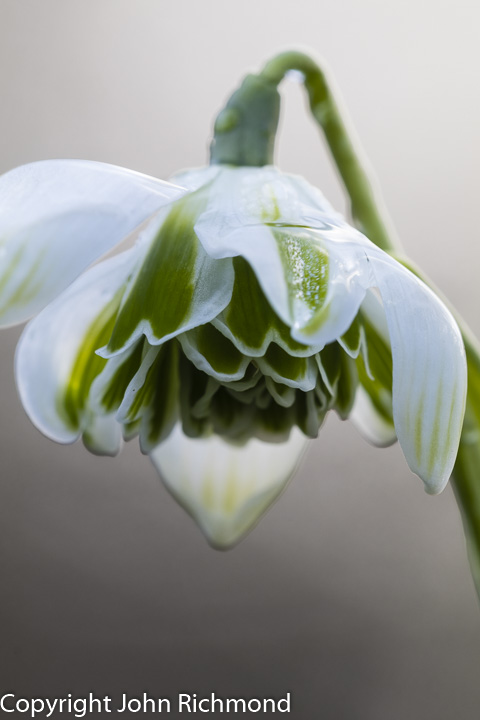
With doubles it’s more common to have an intense doubling of
the inner petals and no doubling of the outer petals. Photographing this isn’t always easy for
snowdrops growing in the garden. They’re
small and hang their heads down – which means working at ground level, usually
with wet knees. But, with persistence,
they do reveal their secrets. More
refined is ‘L.P Long’, particularly when compared with the blowsier ‘Lady
Beatrix Stanley’.
 |
| Galanthus 'L.P.Lomg' |
 |
| Galanthus 'Lady Beatrix Stanley' |
There are times when the situation makes it easy to photograph
up and into the heart of the flowers.
G.nivalis ‘Sam Arnott’ is grown in a raised bed under the wedding cake tree,
Cornus controversa ’Variegata’,
perfectly positioned to admire the green markings on the inner petals.
 |
| Galanthus nivalis 'Sam Arnott' |
Such markings are standard on the inner petals
of most snowdrops but the effect is more
pronounced and even extends to the outer petals in some of the selected forms
grown at The Garden House. Some have the conventional snowdrop flower shape, as
with G.’Alan’s Treat’ or G.plicatus ‘Greenfinch’. Others, such as ‘Trumps’, begin to deviate
from the normal form.
 |
| Galanthus x hybridus 'Trumps' |
 |
| Galanthus 'Alan's Treat' |
 |
| Galanthus plicatus 'Greenfinch' |
Some
varieties take this even further, combining heavy marking with elongated outer
petals. G.nivalis ‘Walrus’ retains elegance but looks very little like a
normal snowdrop while G.’Doncaster’s
Double Sharlock’ offers even further variation on the norm. Fascinating curiosities that were a pleasure
to photograph and admire.
 |
| Galanthus nivalis 'Walrus' |
 |
| Galanthus 'Doncaster's Double Sharlock' |
This is only
a fraction of the collection at The Garden House. There are many more interesting variants on
the basic white with green markings snowdrop design to be seen on the open days
in Winter. If you've previously visited I hope this
will be a reminder to drop in again. If not, well the open days and directions to the garden can be found on The Garden House website. Visit
The Garden House for the latest details.
I’ll finish
with my own favourites, the varieties where green has been replaced with yellow
in the ovaries and the markings. And
what better to illustrate this than G.plicatus
‘Wendy’s Gold’, which flaunts itself close to the entrance to the garden.
 |
| Galanthus plicatus 'Wendy's Gold' |
I'll be out at The Garden House throughout this winter to add more photos to the collection. The images are available for purchase through the Alamy stock agency or by contacting me directly. Many of the species and varieties are available through Matt Bishop's own website.
Matt Bishop's Snowdrops contains all the details and a link to his publications and detailed monograph on the genus (co authors A.Davis and John Grimshaw).