Wednesday, September 12, 2012

Half hardy climbers

Providing it fits in with my 'exotic' theme I always like to try something new in the garden and the use of short lived, half hardy climbers has offered plenty of opportunities over the years.  Even with my relatively mild Plymouth climate their long term survival isn't guaranteed - but they are fun to try even if they only last for a season.  Some last longer, of course, but the one thing they all have in common is their ability to grow freely and flower well in their first year or on annual growth from perennial roots, providing a display up whatever support is available.  Some can be grown from seed, but others are better from cuttings or bought in as young plants.

I've grown a number of different Thunbergia as summer annuals.  This year's feature has been Thunbergia 'Sunshine Susie Red and Orange', a cutting grown variety readily available as small plants early in the season.  Three of these in terracotta pot are growing well up a simple cane framework attached to two downspouts on my house wall.  They've easily reached 8ft / 2.5metres and have produced a continuous sprinkling (it's been too cool and wet for more) of 2in / 5cm reddish orange flowers with contrasting black eyes.

Thunbergia 'Sunshine Susie Red and Orange'
This one should be perennial, with a rootstock capable of taking a degree or two of frost.  I'll cut down the top growth later in the year and store the pot in my shed over the winter and hope for regrowth next year.  This is a process I've used with a couple of other Thunbergia, both of which I kept going for a couple of years before harsh winter reality intervened.  Best of the two was T.gregorii, a true orange.  This even survived outside for a year or two.

Thunbergia gregorii
Thunbergia 'Lemon Queen' was a little more tender and only lasted two seasons - but was still very attractive and far more subtle than the rather strident colouring of the other two.  It took me back to my days as a teacher, growing Black Eyed Susie, Thunbergia alata, for longer term class experiments.

Thunbergia 'Lemon Queen'
There is a triumvirate of seed grown favourites that I keep coming back to in the garden.  Not every one every year but often enough to regard them almost as residents.  Some are - for a year or so if the perennial rootstocks survive one of our milder winters.

Eccremocarpus scaber now comes in a variety of colours, from rarely seen white, through more common yellow, the orange form I've illustrated below, and back to scarcer red.  It's a bit pot luck with a packet of seeds - and who has the room to grow a couple of dozen seedlings on to find the elusive white or red forms?  Not me, I'm afraid.  For all that, even the commoner yellow and orange forms are attractive as they wend their ferny annual foliage through whatever support is handy.  They will seed around and can survive for a number of years through self sowing but plants are rarely as impressive as seed sown early in the year - even the previous autumn - and then grown on in some protection until late spring planting.
Eccremocarpus scaber
Similar early sowing can produce impressive specimens of Cobea scandens by later summer.  This is more vigorous and definitely needs siting in a position where it will not swamp the host plant(s).  It doesn't self sow with me but I have had the rootstock survive a winter to produce a good sized climber the following year.  I've only grown the normal form with it's 3in / 7.5cm bells that open pale cream and darken to their seductive deep purple colour after a short time but there is also a white form if you are looking for something a little different.

Cobea scandens
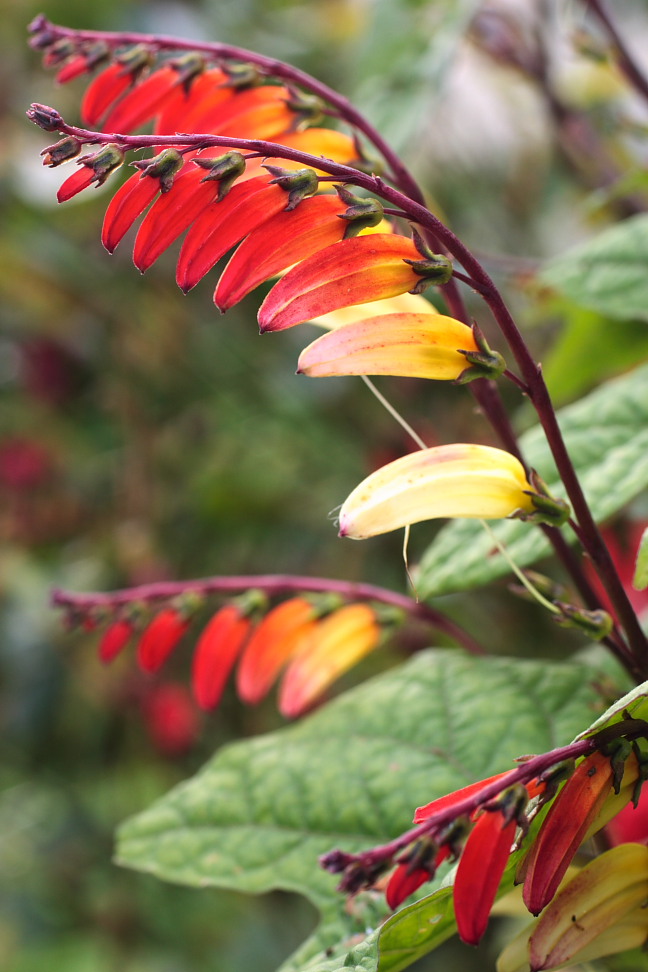
I keep coming back to Mina lobata about every three years.  Related to the Ipomea indica I grow on the south facing house wall (sadly unlikely to flower this year after our miserable summer) this has interestingly attractive spikes of flowers that open red and fade to white after pollination.  Sadly, the hummingbirds that would pollinate this in the wild are not a feature this side of the Atlantic and the job is probably handled by bees and long tongued moths.

Mina lobata
I should really add a fourth to this seed grown group.  The climbing / trailing form of the annual nasturtium, Tropaeolum majus, was a feature of the garden for years, self sowing annually and producing trails of 6-8ft / 2 metres or more by the end of summer.  In warmer climates it can even climb trees but is far more restrained in our cooler summers.  Sadly the two bad winters before this last one seem to have destroyed the stock of freely produced seeds and for the first time in a while I don't have this in the garden.  I must re-introduce it next year.  It can be a bit of a pest - but the flowers in their various reds, yellows and oranges are well worth the occasional need to cut back the trails of foliage.

Tropaeolum majus - climbing / trailing form
Passion flowers, with the notable exception of Passiflora caerulea which has been in the garden for fifteen years now, are mostly just too tender to thrive outside through every winter.  However many do make excellent pot plants, grown up an framework inside the pot or allowed to grow up an external support on an annual basis, the top growth being cut back in late autumn and the pot being stored under cover through the winter in just frost free conditions.  I've had a lot of pleasure from two over the last few years.  'Lavender Lady' is almost hardy with me, only succumbing in the harshest of the recent winters while the extremely dramatic looking Passiflora antioquensis 'Hill House' was a bit more tricky.  Time to try them both again, I think - or one or more of the other varieties.  They do add exotic interest to the garden and, in a normal winter, surge back to fast growing life in spring when given a minimal amount of cold season protection.

Passiflora 'Lavender Lady'

Passiflora antioquensis 'Hill House'
Though not amenable to the extensive cutting back of the more vigorous passion flowers the same treatment works for the evergreen Pandorea jasminoides.  It would undoubtedly flower more abundantly given free reign against a hot, sunny wall but just isn't quite hardy enough with me to survive such treatment.  I've seen it growing well in other south west gardens which enjoy a more favourable micro climate but for me it has to be pot growing and winter protection or nothing.  Still worth while, though, the heads of tubular white flowers with their rosy eyes providing excellent contrast to the glossy evergreen leaves.

Pandorea jasminoides
There are many others I could - and probably will - try but even this limited selection has added greatly to the garden scene over the last few years.  I warmer climates they would be permanent features, commonplace enough to be ignored.  Here, in cool, damp Plymouth they are exotic additions - but surprisingly easy to grow.  For a summer, at least.

Tuesday, September 4, 2012

The sedum is flowering - and with it comes the bees

I have a good many plants that attract pollinating insects into the garden but in early September none are as attractive to the local bee populations as Sedum spectabile.  For the last couple of sunny days I've taken some time to sit by my little clump and record the comings and goings of my neighbourhood bees, attracted by the abundant nectar in the myriad of individual pink flowers that make up the heads of this semi-succulent plant.  There were rather more than I would have thought.

Bear in mind that despite my training as an ecologist I'm not a bee expert so all identifications are tentative.  If I've got any wrong please let me know and I'll edit the post to suit.  As always, click to embiggen the photos.

Honeybees, Apis mellifera, came in their dozens.  Some were the normal lighter coloured form, others the darker bodied form.  There must be at least two hives locally though I've no idea where they are.

Apis mellifera, lighter coloured form

Apis mellifera, darker coloured form
I had quite a few visits from the common carder bee, Bombus pascuorum, one of the bumble bee family.  This is a ground nester, with up to 150 offspring from the overwintered queen over the course of the summer.  Given the brightness of the orange hairs hasn't faded, the two photos below are probably end of season, newly hatched queens stocking up for winter and the chance to produce their own nests next year.  There are enough undisturbed spots in my own and other local gardens to provide nesting sites.

Bombus pascuorum

Bombus pascuorum
Another member of the bumble bee family made a couple of appearences.  Given the lemony colour and the white tip to the abdomen I believe this one is Bombus lucorum though it could be the very similar Bombus terrestris.  As I said, I'm no expert, so feel free to correct me if I'm wrong.

Bombus lucorum

Bombus lucorum
I also spotted a red tailed bumble bee, Bombus lapidarius, but it was gone before I had the chance to photograph it.  No stock photos, I'm afraid, but I'll update if I take one.

Far smaller than the honeybees and bumble bees were a couple of little solitary bees. Lasioglossum species.  These are tiny little things, less than 1cm / 0.4in long - and a challenge to photograph. I use a diffused flash mounted on an articulated bracket so that the flash head sits just in front of my Tamron 90mm macro lens (+25mm extension tube in this case) to give soft, shadowless lighting.  Focusing is manual.  Essentially I set the macro lens to full extension and then slowly lean in to get the shot and fire when the subject comes in to focus.  Easier said than done as the hands and body shake and the insect moves around.  A lot of shots are failures, usually because I haven't nailed the focus exactly.  Thank goodness for digital SLRs - I'd never have been able to afford the film costs back in the days when I shot with Olympus OM cameras and Fujichrome slide film.

Anyway, back to the bees.  I've tentatively identified the one below as a male Lasioglossum calceatum, one of the commonest species in the UK.

Lasioglossum calceatum

Lasioglossum calceatum
I'm definitely not sure about this next one.  It could be a heavily striped male Lasioglossum calceatum or it could be the far scarcer Lasioglossum xanthopus.  Either way, it's a pretty little thing and I'm happy to see it feeding on the sedum.


Of course, where there is prey, there are predators.  The bees may be attracted to the flowers to feed but down below the flower heads, spinning their rather tatty webs were a number of Linyphia triangularis spiders.  Too small to tackle a honey or bumble bee they would certainly make a meal of the little solitary bees should they blunder into the webs.  Nature is often cruel.

Linyphia triangularis

It is sometimes said that ornamental gardens aren't places for wildlife.  Nothing could be further from the truth.  Providing that pesticides are not used (or at least very sparingly) even a more exotic garden can attract a variety of wildlife.  It may be small - but it's there.


Tuesday, August 28, 2012

Hedychium densiflorum 'Stephen'

I have a liking for ginger lilies, Hedychium species and varieties, though the size of a well grown clump compared to the space I have available precludes me from growing more than a few.  In UK conditions many are perfectly hardy, either dying down naturally or being cut down by frost to tough, winter hardy rhizomes which are often late to emerge the following spring but make up for it with swift growth of tall stems clothed with long, strap like leaves.  What they are not so good at is reliable flowering in our cool summer conditions.  But there are some exceptions.

In my small collection the earliest to flower is always Hedychium densiflorum 'Stephen'.  Naturally deciduous, hardy - though it did suffer in the recent harsh winters but has bounced back strongly - tall - to 5ft / 150cm or more - and with broad, exotic leaves well spaced up the pseudostem, it fits in well with my tropical style of gardening.

Collected by Tony Schilling in Nepal, 'Stephen' (and the similar 'Sorung' from a later collection) are atypical of the species and its other varieties in that both the terminal flower head and the whole plant are far larger.  Compare these two photos:

Hedychium densiflorum 'Assam Orange'
Hedychium densiflorum 'Stephen'


The flower heads of H.densiflorum 'Assam Orange' are thinner and little more than half the height of the 10in / 25cm heads of 'Stephen'.  In a garden setting, although the colouring of H.densiflorum is attractive, it's a far less desirable plant (unless you are a collector rather than a selector).  With limited space, I made my choice and 'Stephen' has fulfilled the mandate for a tall, tropical looking perennial with exotic flowers.

Here it is in my own garden.  I don't have room for a massive clump so I periodically have to split the rhizomes to keep it in bounds.  Nonetheless, the effect is what I wanted - even if there is nothing visible until late May.

Hedychium 'Stephen' in the garden

Hedychium 'Stephen' in the garden

There is, of course, a fly in the ointment.  Individual flowers are ephemeral, lasting a couple of days at most.  They have a sweet scent, particularly in the evening, that readily attracts pollinators and so they soon pass over.  The head opens flowers progressively from the base to the tip but the whole thing is fleeting.  Five or six days from first opening to final decay is typical.  There is a small variation in the time that the heads develop but don't expect the entire flowering to last longer than a fortnight.  But it's worth it - and if the autumn is warm enough I often get one or two new flowering stems before winter interrupts and the plants cycle down for their dormant season.  I even get the odd scarlet seed - though not recently, so no photos I'm afraid.