Friday, March 30, 2012

The bananas are back

A couple of weeks of unseasonal warmth for the end of March has really accelerated the new spring growth in the garden.  It has helped that the winter now, hopefully, over was shorter and milder than the previous three years - but even so, this year looks like being advanced in its seasons.  And it has certainly brought the bananas back to life a little earlier than I expected.

I grow three.  The 'hardy' banana Musa basjoo; the red abyssinian banana Ensete ventricosum 'Maurelii'; and the Chinese dwarf banana, Musella lasiocarpa.  All were new last year, replacements for older plants I lost over the previous two winters.  All three have survived last winter.  With protection.  I've learned a good deal since my more optimistic exotic gardening days of a few years ago.  Fortunately, all three are readily and cheaply available as summer bedding plants thanks to tissue culture propagation techniques so replacement wasn't too painful.  Even so, they'll be far larger and do far better in their second year so successful overwintering is a definite bonus

Musa basjoo spent last summer in a large pot.  I only bought it in July so it didn't really have a chance to get going before autumn and then winter slowed growth.  We had one bad week in early February when I had to provide some in situ protection but it has stayed outside all winter long.  I find that the fleshy stems will take about -5 or -6C before terminally succumbing to frost though well established clumps can regenerate from the roots after even lower temperatures.   For ultimate height, though, you do need to protect the stems from year to year.  I never did with my old clump and the 2009-2010 winter finished it off.  Though not before it got to this size:

Musa basjoo towers over Dicksonia antarctica summer 2007
Sadly this was the peak of it's growth.  My neighbours had removed a good deal of hedging and tall shrubbery which deprived the clump of wind protection.  The foliage never looked good and the clump was declining in vigour even before harsh winter weather finished it off.

Now I'm starting again. So it was a relief to lop the dry, blackened top third of my single stemmed plant to reveal an intact growing point.  Two weeks later and growth is evident. 

New roller developing on Musa basjoo
Now to find a well manured, sunny spot out of the wind for the explosion of summer growth.

Ensete ventricosum 'Maurelii' must be one of the most spectacular perennials that can be grown in cool temperate climates.  Even as a young plant it oozes exotica.  This was mine after four months growth last year:

Ensete ventricosum 'Maurelii', Autumn 2011
The standard advice is to grow the plant in full sun.  Mine was in the shade of my camellia / chusquea / cordyline dividing 'wall' in the middle of the garden.  It thrived.  I don't think I've seen better colours on this plant, sumptuous wine red undersides to the paddle shaped leaves, dark bronzed upper sides.  It looked spectacular. 

Overwintering consisted of digging up the plant with a small rootball, draining off the water that collects in the leaf bases by inverting it for a couple of days and then standing it upright in a tiny pot in the corner of my little shade house.  When the weather got frosty I moved it inside - then out again when conditions eased.  Here's the pot.  It's only for support.

Ensete ventricosum 'Maurelii' in its overwintering pot
It started regrowing about three weeks ago.  This is how it looked today:


Growth is astonishingly fast.  It's now too big for the spot I had it last year - but I've got another spot picked out.  Not in shade this time.

The final one of my bananas is Musella lasiocarpa.  Again, I've grown it before and lost it to the unexpected harsh winter of 2009 - 2010.  So I couldn't resist a very cut price end of season specimen in one of my local DIY sheds last Autumn.  This overwintered unprotected and is now sprouting again.  No pictures of this one yet - but I'll take some in the summer when I expect it to be an interesting part of my display.

Thursday, March 29, 2012

How brief the blossom

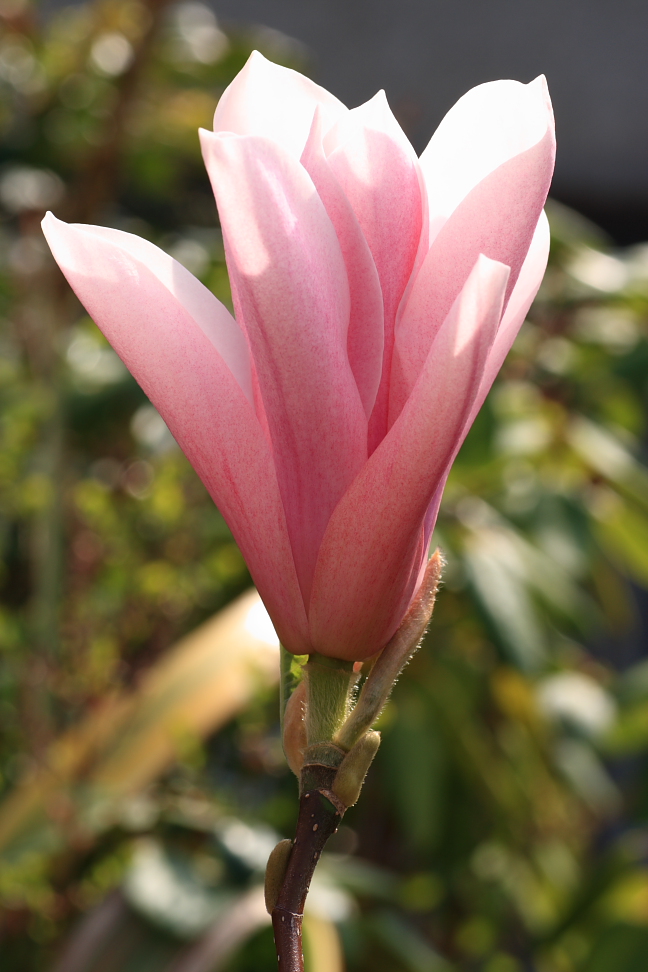
I love magnolias.  Descended from one of the earliest types of flowering plants their giant blooms are very primitive biologically but gorgeous aesthetically.  In a small garden I only have room for one, a hybrid called 'Raspberry Ice'.  After a dozen years (and one move which set it back for a while) it's now about 12ft / 4 metres high and carrying ever greater quantities of flowers for it's brief spring blooming.  It started in flower late last week, was at it's best Monday and Tuesday of this week but the flowers are now shattering, accelerated in their decline by some unusually warm weather and a persistent wind. 

Add caption

 
Just a few days beauty - but worth it.

Wednesday, February 8, 2012

On cold and camellias

We've just had a - hopefully brief - cold snap.  Down to -7C according to the sensor in Maria's car last Friday morning.  It's the first serious frost of the winter but has hit just when the camellias are coming into their full display.

I've got six in the garden and, successively, they give me colour from November to April.  The season starts with a Camellia sasanqua variety (I've lost the label but I think it's Shishi Gashira).  It's trained against a west facing wall and is now in semi shade so doesn't flower as freely as it should.  Even so, the relatively small, deep pink, semi double flowers are a welcome sight in November and December.  This one usually manages to avoid the flower damage a period of frost can bring.  But others are not so lucky.

Camellia sasanqua variety
Camellia 'Cornish Snow' I've blogged about before but this winter it started flowering in November and has carried on as the days have got colder.  Because we haven't had a sub zero frost until late last week the flowers have remained undamaged and really have brightened the darker months of December and January. 

Camellia 'Cornish Snow'
Which brings me to the ones that have just begun their flowering season.  These are all varieties of Camellia x williamsii, offspring of the many times repeated C.saluenensis / C.japonica cross that has yielded hundreds of free flowering, hardy and very desirable camellias since it was first tried at Caerhays (a famous Cornish garden) in 1923.

'St Ewe' was the first in flower, just after Christmas.  It has perfect single flowers and a long season from January to April with me.  Like all the C. x williamsii hybrids it has the invaluable ability to shed dead and frosted flowers of it's own accord.  The buds are frost resistant.  The flowers are not.  We get short periods of freezing weather so, inevitably, some flowers get frosted.  With the x williamsii varieties these will soon drop to be replaced by the next set of buds.  With other camellias - notably C.japonica - the dead flowers hang on and on - the bush becomes very unsightly.

Camellia 'St Ewe'
Next off the blocks this year was 'Donation', one of the best known of all camellias.  Hardly surprising.  The combination of prolific flowering and attractive blooms is attractive to anyone with the required acid soil.  The neat shrub form - though it can certainly grow large in time - provides additional attraction throughout the year.

Camellia x williamsii 'Donation'
The final one to flower is the heavily doubled 'Anticipation'.  My shrub is about 8ft / 2.5 metres high after 14 years and flowers profusely, brightening the late winter/early spring days.

Camellia x williamsii 'Anticipation'
Superb camellias and well worth the space the occupy in my small garden.

But the season doesn't stop here.  In a month the fat buds of my single Camellia japonica  variety will be open to produce absolutely formal semi double pink flowers.  It was sold to me as a variety it's definitely not.  I think it may be 'Magnoliaeflora' but I can't be certain.  Whatever it is, its small flowers are a definite adornment although a single night's frost can cover the bush with blossoms gone to brown decay.

Camellia japonica - a white semi double, possibly Magnoliaeflora'
Even out of flower camellias look good with their simple, glossy evergreen leaves and neat habits.  But, even with the continued risk of frost and snow, now is their season and now is their true delight to be seen.  I'll be visiting local gardens over the next couple of months and they will be in full flower, a beautiful start to the new year.