Friday, April 6, 2012

Maybe I shouldn't have put that there

Is it just me - or is it every gardener that makes the same mistake of inappropriate planting?

Gardening is a four dimensional art.  Other art forms merely have to worry about two or three dimensions.  We have to worry about four.  Length, breadth, height - and time.  Plants - assuming we're successful in our endeavours - have this nasty habit of growing.  Sometimes slowly, sometimes rapidly.  But, unless our thumbs are brown rather than green, grow they do.  I've seen it described as slow sculpture.  Could there be a better description?

I've just spent an hour (I'm old, it takes time!) digging out an inappropriately sited golden variegated bamboo from its site on the south side of my little garden pond.  It was too big for the site.  Fifteen years ago, when I planted a small offset donated from my father's garden, it wasn't.  But, gradually, over the years, it's slowly increased in size and was now beginning to overshadow the pond with it's 6 ft / 180cm height and ever increasing girth.  I've known that I had a problem for a year or three - but have done nothing about it.  Today I bit the bullet and removed the beast.

Pleioblastus auricomus - moved, not discarded


Don't worry too much.  This is not a tale of devastation.  I've moved a small chunk to a new location in the garden and will distribute other bits to friends and family.  But it got me thinking about my other plantings that may not have taken full account of that fourth dimension of gardening.

For example, should I really have planted Yucca gloriosa 'Variegata' quite as close to my sitting area as I did?  It's beautiful and, as a younger plant, was well within bounds.  It then grew and now the sharp spines dig into anyone sitting too close. Unwelcome vistors are shown to that seat.

And maybe I shouldn't have placed Mahonia japonica quite that close to my front entrance path.  Yes, it's a little prickly, but surely the occasional visitor laceration is compensated for by the gorgeous winter scent.

I could go on with tales of a Dicksonia antarctica tree fern that I never expected to grow as fast and now needs to be moved 3 feet / 1 metre backwards to enable access to the greenhouse; the Canary Island date palm that was threatening to block my living room window before a severe winter interrupted (terminally) its growth; a Camellia 'St Ewe' and Acer 'Bloodgood' combination that I've had to butcher to get access to my front door.  There are many other examples.

Faced with bare earth it's far too easy to plant closely to fill the gaps.  The years slip by and suddenly that spindly little purchase that looked so lost when first added to the garden has achieved impressive maturity.  And it's in the wrong place.  Aargh, time to get out the spade.

Friday, March 30, 2012

The bananas are back

A couple of weeks of unseasonal warmth for the end of March has really accelerated the new spring growth in the garden.  It has helped that the winter now, hopefully, over was shorter and milder than the previous three years - but even so, this year looks like being advanced in its seasons.  And it has certainly brought the bananas back to life a little earlier than I expected.

I grow three.  The 'hardy' banana Musa basjoo; the red abyssinian banana Ensete ventricosum 'Maurelii'; and the Chinese dwarf banana, Musella lasiocarpa.  All were new last year, replacements for older plants I lost over the previous two winters.  All three have survived last winter.  With protection.  I've learned a good deal since my more optimistic exotic gardening days of a few years ago.  Fortunately, all three are readily and cheaply available as summer bedding plants thanks to tissue culture propagation techniques so replacement wasn't too painful.  Even so, they'll be far larger and do far better in their second year so successful overwintering is a definite bonus

Musa basjoo spent last summer in a large pot.  I only bought it in July so it didn't really have a chance to get going before autumn and then winter slowed growth.  We had one bad week in early February when I had to provide some in situ protection but it has stayed outside all winter long.  I find that the fleshy stems will take about -5 or -6C before terminally succumbing to frost though well established clumps can regenerate from the roots after even lower temperatures.   For ultimate height, though, you do need to protect the stems from year to year.  I never did with my old clump and the 2009-2010 winter finished it off.  Though not before it got to this size:

Musa basjoo towers over Dicksonia antarctica summer 2007
Sadly this was the peak of it's growth.  My neighbours had removed a good deal of hedging and tall shrubbery which deprived the clump of wind protection.  The foliage never looked good and the clump was declining in vigour even before harsh winter weather finished it off.

Now I'm starting again. So it was a relief to lop the dry, blackened top third of my single stemmed plant to reveal an intact growing point.  Two weeks later and growth is evident. 

New roller developing on Musa basjoo
Now to find a well manured, sunny spot out of the wind for the explosion of summer growth.

Ensete ventricosum 'Maurelii' must be one of the most spectacular perennials that can be grown in cool temperate climates.  Even as a young plant it oozes exotica.  This was mine after four months growth last year:

Ensete ventricosum 'Maurelii', Autumn 2011
The standard advice is to grow the plant in full sun.  Mine was in the shade of my camellia / chusquea / cordyline dividing 'wall' in the middle of the garden.  It thrived.  I don't think I've seen better colours on this plant, sumptuous wine red undersides to the paddle shaped leaves, dark bronzed upper sides.  It looked spectacular. 

Overwintering consisted of digging up the plant with a small rootball, draining off the water that collects in the leaf bases by inverting it for a couple of days and then standing it upright in a tiny pot in the corner of my little shade house.  When the weather got frosty I moved it inside - then out again when conditions eased.  Here's the pot.  It's only for support.

Ensete ventricosum 'Maurelii' in its overwintering pot
It started regrowing about three weeks ago.  This is how it looked today:


Growth is astonishingly fast.  It's now too big for the spot I had it last year - but I've got another spot picked out.  Not in shade this time.

The final one of my bananas is Musella lasiocarpa.  Again, I've grown it before and lost it to the unexpected harsh winter of 2009 - 2010.  So I couldn't resist a very cut price end of season specimen in one of my local DIY sheds last Autumn.  This overwintered unprotected and is now sprouting again.  No pictures of this one yet - but I'll take some in the summer when I expect it to be an interesting part of my display.

Thursday, March 29, 2012

How brief the blossom

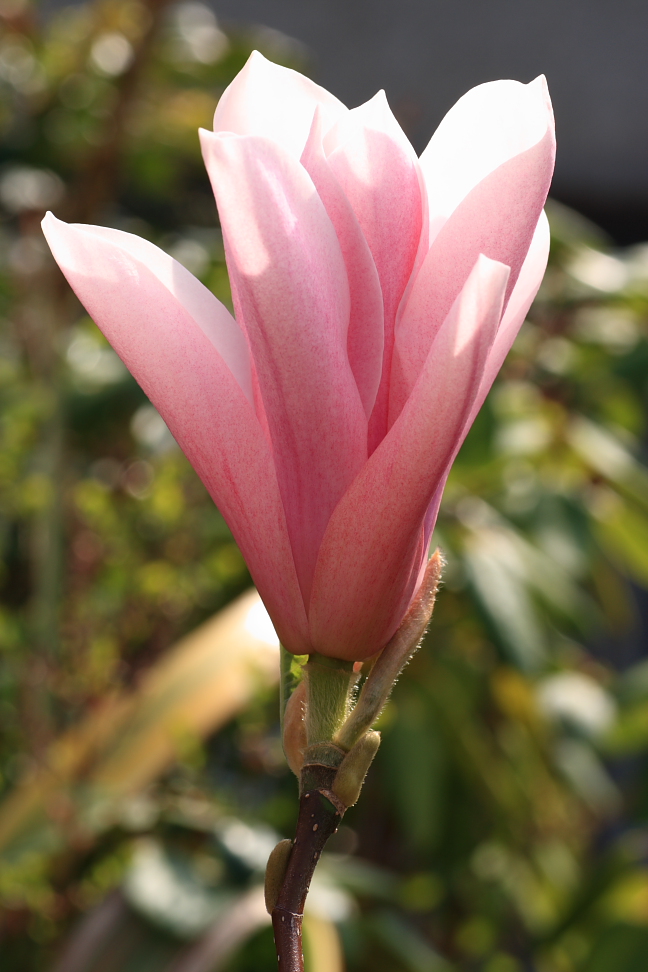
I love magnolias.  Descended from one of the earliest types of flowering plants their giant blooms are very primitive biologically but gorgeous aesthetically.  In a small garden I only have room for one, a hybrid called 'Raspberry Ice'.  After a dozen years (and one move which set it back for a while) it's now about 12ft / 4 metres high and carrying ever greater quantities of flowers for it's brief spring blooming.  It started in flower late last week, was at it's best Monday and Tuesday of this week but the flowers are now shattering, accelerated in their decline by some unusually warm weather and a persistent wind. 

Add caption

 
Just a few days beauty - but worth it.