Another 15th of the month and a chance to show some of what's flowering in my small Plymouth garden for Garden Blogger's Bloom Day.
It's been very pleasant recently. Dry, comparatively warm (this is spring in England!), and generally sunny. So the plants are responding. My Fuchsias and French lavender are in bud;
Dicentra spectabiis and my Spanish bluebells have just opened their first flowers;
Scilla peruviana should open the first flowers in a day or two to produce tight spheres of blue; the camellias, though past their peak, are still in flower; yellow and pink primroses are abundant; even my
Magnolia 'Raspberry Ice' still has a few flowers hiding among the emerging foliage.
So, what's looking at it's best?
One feature plant that enjoys a few brief weeks of glory at this time of year is the fastigiate flowering cherry,
Prunus 'Amanogawa'. It's very difficult to photograph. At about 30ft / 9m in height it dominates the rear garden and it's hard to get an angle that includes the tree without including all the surroundings. In the end I put the camera with 28mm lens on the tripod, pointed it up and took this snap of the cherry towering into the sky.
 |
| Prunus 'Amanogawa' - looking up into the upright canopy |
More conventionally, here's a close-up of the flowers.
 |
| Prunus 'Amanogawa' flowers |
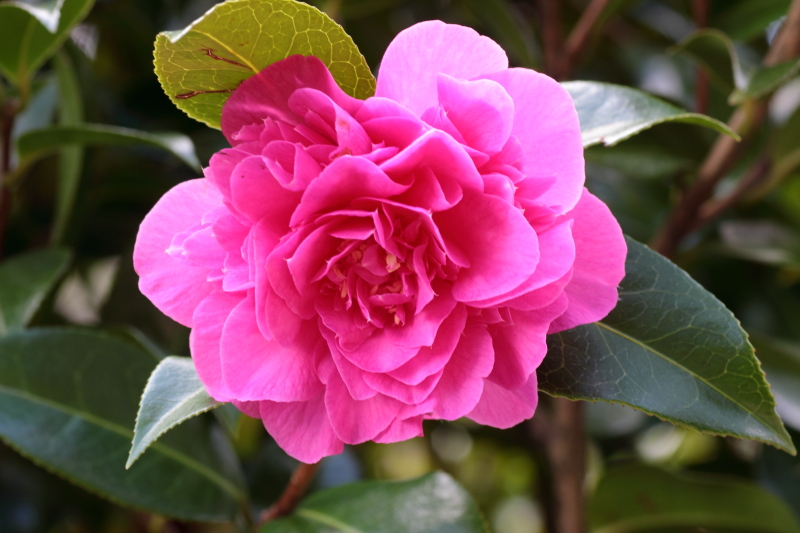
Camellia japonica 'Magnoliaeflora' in the front garden is the last of my camellias to flower and this year has been no exception. It only had buds a month ago but has since produced it's delicate double blooms with comparative abundance. It's small flowered compared to the
C.
x williamsii hybrids I grow but very attractive.
 |
| Camellia japonica 'Magnoliaeflora' |
Down at ground level the epimediums are producing their spring growth and beginning to flower. Most I've illustrated before but
Epimedium wushanense 'Caramel' is comparatively new and deserves it's place in the sun.
 |
| Epimedium wushanense 'Caramel' |
In recent years there has been an influx of Epimediums from China and nearby areas. I'm gradually acquiring a few (finding space is the biggest problem). They usually have good foliage, often attractively marked in spring.
E.wushanense 'Caramel',
E. franchettii 'Brimstone Butterfly' (in bud), and
E.myrianthum (still waiting for emergence) are far superior to my European hybrids. 'Brimstone Butterfly' has particularly attractive red foliage when young while the other two are marbled. I must get more.
The wood anemones, varieties of
Anemone nemorosa in the front garden seem to spring from nowhere to flowering in a few brief days at this time of year. I've illustrated the species and its varieties before so won't repeat myself but I have finally got a decent shot of the hybrid between
A.nemorosa and
A.ranunculoides, Anemone x lipsiensis, so I'll use that to illustrate the tribe.
 |
| Anemone x lipsiensis |
The white variegated evergreen
Pieris japonica 'Flaming Silver' looks good at any time of year but never better than now, with bright red young growth, white edged old growth, and, after a good summer last year, flowers. It's slow growing but worth the wait.
 |
| Pieris japonica 'Flaming Silver' |
I illustrated
Chasmanthe bicolor last month when a potted clump was showing the first flowers. Things have developed since then and my planted out clumps are also flowering. The mild, damp winter must have done them a lot of good. Here's a shot to better show the delicate arching of the flower stem.
 |
| Chasmanthe bicolor |
Clambering in and over my little shade house (bare at this time of year but soon to be re-occupied with tender shade lovers currently sheltering indoors) is
Akebia quinata, the chocolate vine. A weed species in warmer climates, it's well behaved here. The larger female and smaller male flowers are carried in a single infloresence to produce a very interesting April effect.
 |
| Akebia quinate showing larger female and smaller male flowers |
Still small, but well able to scent a good area of the garden is
Skimmia japonica 'Rubella', a male variety of this Japanese evergreen. I haven't had it too long and am still growing it on to eventually occupy a shaded spot under the Prunus. OK, it's commonplace - but still good value with red buds through the winter and white flowers in March and April.
 |
| Skimmia japonica 'Rubella' |
One new addition I couldn't resist during a recent visit to the
Duchy of Cornwall nursery (well worth visiting if you are ever down this way) is a large flowered Hebe.
Hebe macrocarpa var
latisepala is a tender, winter and spring flowering New Zealander. I've previously grown the equally tender, red, large flowered
Hebe speciosa 'Simon Delaux' until it succumbed to a hard winter a few years back and I reckon this one is worth a try. I have a little bit of space in the warm border under my house wall in the rear garden so it should be worth the risk - and Pippa has conveniently dug a hole in exactly the right place. So many hebes have small flower heads. These are definite step up.
 |
| Hebe macrocarpa var latisepala |
As ever, my thanks to
May Dreams Gardens
for hosting the Garden Bloggers' Bloom Day meme. Head over there to
see what's flowering in many more gardens round the world.